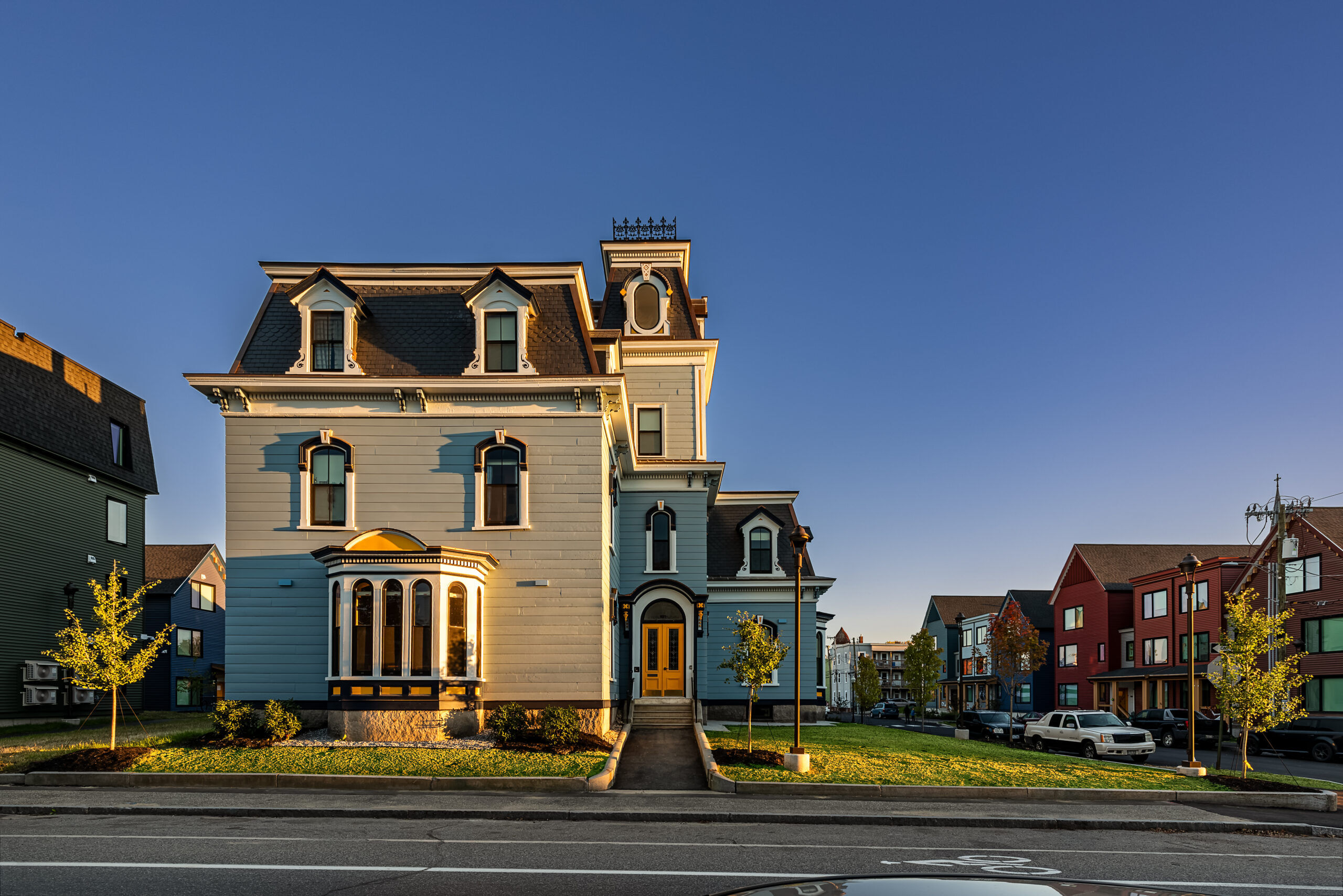
MEREDA Recognizes its 2025 Notable Project Award Recipients
Each year, the Maine Real Estate & Development Association (MEREDA) recognizes some of the state’s most “noteworthy and significant” real estate projects, completed in the previous year. The exemplary projects from across the state, completed in 2025, not only embody MEREDA’s belief in responsible real estate development, but also exemplify best practices in the industry, contributing to Maine’s economic growth by significant investment of resources and job creation statewide.
This year, MEREDA honored projects from throughout the state, with each receiving special recognition at MEREDA’s 2026 “Notable Night” social celebration in April.
In a multi-part series exclusive to the Maine Real Estate Insider published by Mainebiz, we’ll provide an up-close look at the most notable commercial development projects of the past year that are helping to fuel Maine’s economy in terms of investment and job creation. MEREDA is proud to recognize responsible development based upon criteria including environmental sustainability, economic impact, energy efficiency, difficulty of the development, uniqueness, social impact and job creation.
Mainebiz also featured each of our Notable Project Recipients in their second annual “Groundbreaking Maine” publication. Be sure to check it out!
MEREDA’s 2025 Top 7 recipients include:
The Downs, M&R Development (Scarborough)
Estabrook's Pownal Production Facility, Estabrook Farm & Greenhouse, Inc. (Pownal)
UNE Harold & Bibby Alfond Center for Health Sciences, SMRT Architects & Engineers (Portland)
Wedgewood, Avesta Housing & Lewiston Housing (Lewiston)
University of Maine Shawn Walsh Hockey Center and Harold Alfond Sports Arena Renovations and Additions, University of Maine (Orono)
Boyd Block (178 Middle Street), East Brown Cow (Portland)
Gehring House, Northern Forest Center (Bethel)
Please join us this week in celebrating Wedgewood.
MEREDA: Describe the building and project.
Wedgewood: Wedgewood is an 82-unit, $49 million, mixed-income residential project funded under Lewiston’s HUD Choice Neighborhoods program. Together with DeWitt – the second Choice phase now under construction – it represents a landmark in historic preservation, affordability, sustainability and community-led revitalization as well as 10 years of coordination between the city, Avesta Housing, Lewiston Housing and local stakeholders.
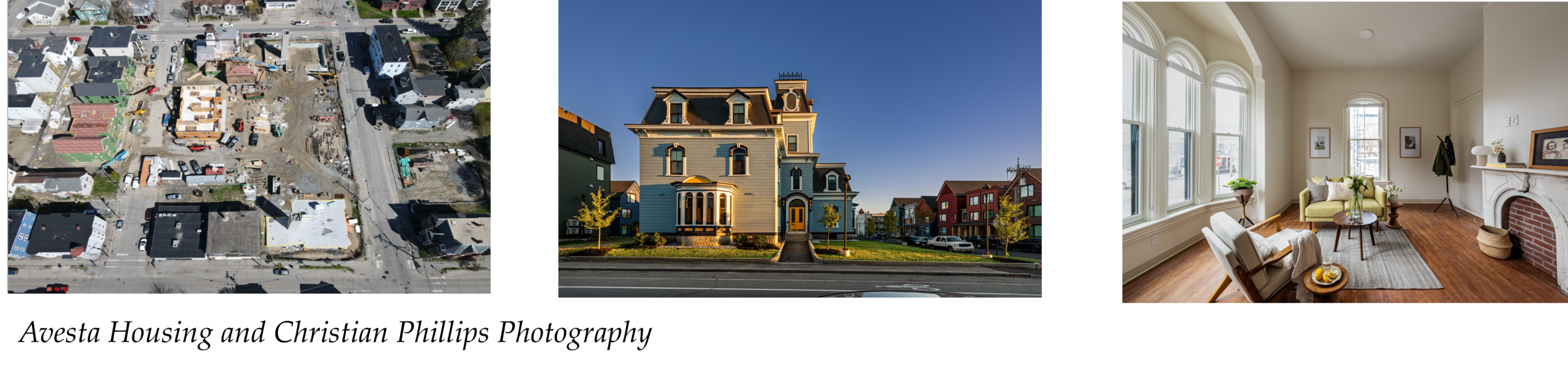
Spanning 14 parcels, Wedgewood reflects Maine’s values of contextual design, historic preservation and durable construction. The site includes nine structures designed to complement Lewiston’s architectural character: eight new buildings echoing the city’s iconic triple-deckers and one restored landmark, the historic Dr. Milton Wedgewood House, a circa-1873 Victorian listed on the National Register of Historic Places. Once in severe disrepair, this house now anchors the development, blending award-winning preservation with modern living while delivering an uncommon supply of family-sized apartments and meeting a growing need across Maine.
The new buildings are Energy Star-certified and meet Enterprise Green Communities standards. They feature high-performance building envelopes, heat-pump heating and cooling systems, fresh air ventilation, Energy Star-certified appliances, LED lighting and water-efficient fixtures. They were designed to accommodate rooftop solar, which is scheduled to be installed later this year.
MEREDA: What was the impetus for this project?
Wedgewood: In 2018, the City of Lewiston applied for and received a HUD Choice Planning Grant to facilitate deep community organizing and visioning for the future of the city; specifically, the Tree Streets neighborhood. Wedgewood was envisioned as a “model block” to replace vacant, distressed properties in the neighborhood with a walkable residential community.
MEREDA: How long were you in the planning stages before construction started?
Wedgewood: Wedgewood is the culmination of years of planning and investment, a model example of what can be built when the community comes together and has the financial resources to dream big when addressing difficult housing problems. Receipt of the HUD Choice Planning Grant in 2018 led to the creation of a 150-plus-page Transformation Plan, which was the blueprint for a subsequent Choice Implementation Grant application in 2020.
Lewiston received the HUD Choice Neighborhoods award in spring 2021, and the team immediately began applying for low-income housing tax credits and other funding for Wedgewood and subsequent phases of development. Financing was largely in place by early 2023, and construction began in July 2023. The first building was completed in fall 2024; the last building in fall 2025.
MEREDA: Tell us about the most challenging aspect of getting this project completed.
Wedgewood: The scale of this development, both in financial scope and physical scope, created a very complex challenge. The cornerstone funding source, the HUD Choice Neighborhoods Award, was just one of a dozen sources that funded the deal. Other sources included City HOME and tax increment financing, a state-allocated subsidy, the Federal Home Loan Bank of Boston Affordable Housing Program, and state and federal low-income housing tax credits and historic tax credits. These varied sources had to be balanced and coordinated to ensure that the development complied with regulatory requirements, met underwriting criteria, and aligned with the construction timeline and scope.
Similarly, the varied buildings (including the significant historic renovation of the Wedgewood house) required an attentive design process by the architect, Kaplan Thompson Architects, and close management by the general contractor, Hebert Construction. Tracking cost and contracts across nine buildings, managing simultaneous construction locations within the site, and then transitioning into partial occupancy as buildings were completed meant the team had to work closely and diligently to maintain project goals and compliance.
MEREDA: Something unexpected you learned along the way was….
Wedgewood: Never assume you know what lies behind a finished wall! The historic Wedgewood house posed a significant challenge during design and construction. During the design process, we had to balance historic preservation and priorities with requirements for modern, accessible living – things like clearances, accessible routes, heating and cooling systems, and energy efficiency standards – alongside historic details and features. We continued to uncover new challenges during the construction phase. The building had a long history of disrepair, most notably from the result of several fires that had created significant structural damage within the building’s walls.
MEREDA: Now that it’s complete, what feature of the project do you think makes it the most notable?
Wedgewood: Wedgewood meets critical housing needs in a city dominated by aging walk-ups, ensures inclusivity and long-term livability for residents, and sets a new standard for neighborhood revitalization. It not only preserved a community landmark, it also transformed 13 vacant lots in one of the state’s lowest median-income census tracts into a single campus of beautifully designed, modern, spacious, healthy and affordable homes. Consistent with the vision of the HUD Choice program, Wedgewood creates homes that people will choose to live in – not just live in because they don’t have a better option.
The elaborate list of over a dozen funding sources made it possible to make intentional choices about the design and site plan, including the campus approach: Wedgewood distributes 74 units across eight new buildings that maintain neighborhood-scale design features such as gabled roofs, turrets and height similarities so that they are true to the character of the city. The buildings also feature a variety of homes, including apartments with up to four bedrooms in response to community needs as well as townhouse-style homes with private front entrances and ADA features. By blending new construction with neighborhood character, Wedgewood delivers significant housing volume and sets a precedent for inclusive, context-sensitive development. And by replacing deteriorated units with stable, mixed-income housing, Wedgewood also strengthens surrounding property values, encourages additional reinvestment, and increases local spending that benefits neighborhood businesses and contributes to downtown Lewiston’s broader economic momentum.
For more information on these seven impressive projects, please click here.